Publications
“Occupiers in a Strange Land: A Virginia Community’s Wartime Experiences in 1862,” in Hundreds of Little Wars: Community, Conflict, and the Real Civil War, eds. G. David Schieffler and Matthew Stith (Louisiana University Press, 2025): 45-62.
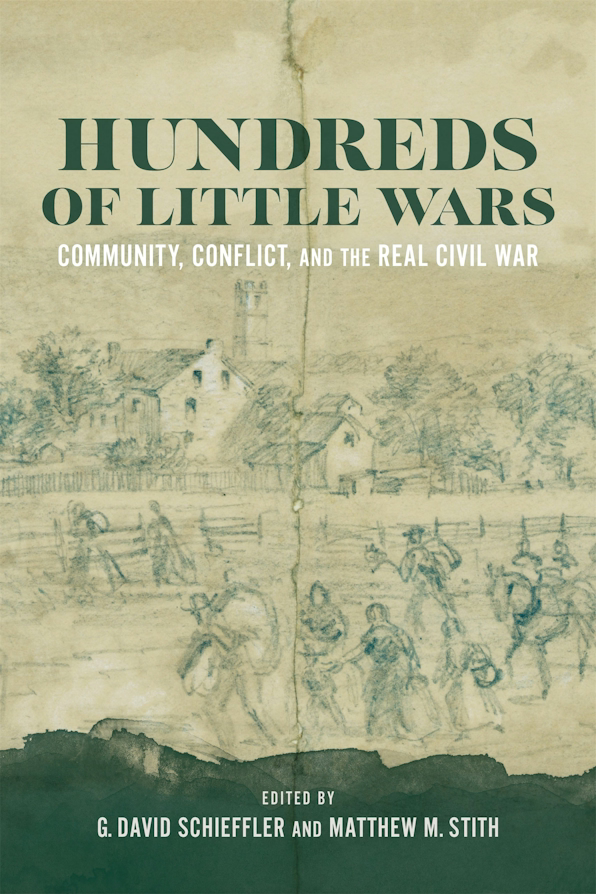
From LSU Press: “From Texas to Virginia, towns, regions, counties, regiments, prisons, and even refugee camps played a significant role in shaping the contours of the Civil War. According to historian Daniel E. Sutherland, whose many books and essays helped establish the field of community studies, these varied assemblages of individuals experienced and fought the real war. Following his lead, the contributors to Hundreds of Little Wars reveal how viewing the war from the vantage point of singular communities allows us to better understand the larger conflict.”
Although they had been feeding, supplying, and tending the wounded Confederate army for almost a year, war seemed to officially arrive for the people of Fauquier County, Virginia in March 1862 when the Twenty-Eighth Pennsylvania Infantry marched into the area. The county was largely a secessionist stronghold and so both the occupied and occupiers were faced with a side of war neither had yet experienced. My chapter explores the relationships between Union soldiers, Confederate sympathizers, and enslaved African Americans in Fauquier County during the spring and summer of 1862. Amidst a backdrop of shifting war aims, the people of Fauquier found themselves on unstable ground where battle lines were blurred. For enslaved men and women of the county, this was an opportunity to gain freedom. For elite whites, it was a test of their loyalty to their new country. This period, and this place, illustrates the challenges in understanding the ways in which occupation altered not only southerners’ lives, but also influenced the changing strategy of the war. The citizens were not combatants but nor were they passive residents. In places like Fauquier, new definitions of “battlefield” and “homefront” are needed. The only way to understand and create these new definitions is to study the war the same way in which southerners lived it: at the local level. If the residents of Fauquier wished to survive, all involved, enslaved and free, soldier and civilian, had to learn the new rules that governed life on the border.